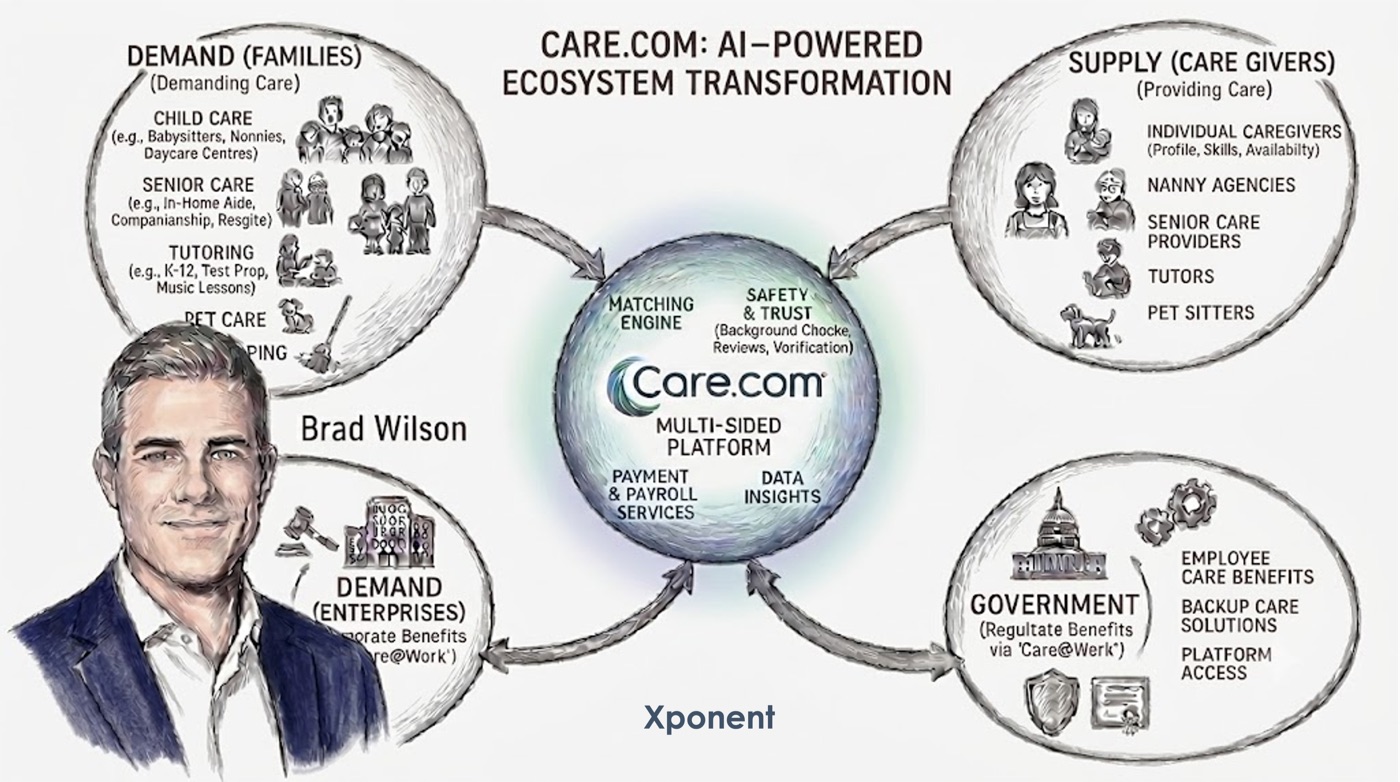

The caregiving economy in the United States is structurally broken. Families spend 20 to 40 percent of household income on care-related expenses, yet the professionals who deliver that care remain chronically underpaid. The gap between what families can afford and what caregivers need to earn is not a market inefficiency, it is a systemic failure that no single actor can resolve alone. Care.com, the largest digital marketplace connecting families with caregiving professionals, is now attempting to close that gap through a broad AI-driven transformation that expands across platform modernization, business model redesign, AI-driven operations, and public policy engagement into a single strategic arc.
With more than 45 million users across 16 countries and approximately 700 enterprise clients, Care.com is the undisputed market leader in a sector where demand is accelerating and supply remains fragmented. The company operates at the intersection of consumer marketplace dynamics, enterprise benefits infrastructure, and one of the most emotionally complex service categories in the economy. Its current transformation offers a case study in how platform businesses can sequence operational rebuilds, product innovation, and ecosystem expansion — even when starting from a position of significant technical debt and suboptimal marketplace performance.
The Burning Platform: Why Care.com's Marketplace Was Not Converting
When new leadership arrived at Care.com in early 2023, the company possessed two undeniable assets: a powerful brand with deep consumer recognition, and the largest caregiver supply pool in the market, a moat that is extraordinarily difficult to replicate in any two-sided marketplace. What it did not possess was a product experience capable of monetizing those assets at scale. The core metrics told a stark story:
- Conversion rates: the percentage of users who actually paid for the service, sat below two percent, well south of the two-to-six percent range that healthy consumer marketplaces typically achieve.
- Match rates: the ultimate measure of marketplace value delivery, were substandard. Messaging responsiveness between families and caregivers was, by the company's own admission, "astonishingly low." In a freemium model where revenue is gated at the point of communication access, every percentage point of conversion loss represents significant foregone revenue and, more critically, a family that did not find the care it needed.
The root cause was not strategic, it was architectural. Years of federated development had produced a technology stack where authentication, messaging, payments, and trust and safety systems all operated as disconnected components. The enterprise side of the business and the consumer side ran as semi-independent operations with separate supply pools, separate product teams, and separate roadmaps. The result was a platform that could not iterate quickly, could not unify its caregiver supply, and could not deliver the fast-twitch experimentation cycles that modern marketplace optimization demands.
Beyond the internal challenges, the macroeconomic context added urgency. Ninety percent of families with care responsibilities report losing sleep over the burden of coordinating and financing care. Eighty-nine percent report burnout. These are not soft sentiment indicators — they are demand signals from a market that is actively searching for better solutions and will move to whoever delivers them first.
The Transformation Framework
Care.com's transformation is not a collection of disconnected business and technological initiatives. It is a whole-business-model redesign across three mutually reinforcing layers: product, operations, and technology. Together, these layers address the central constraint of the care economy: families cannot afford to pay materially more, caregivers cannot afford to earn less, and the platform cannot scale its service model if every new interaction adds proportional cost and complexity.
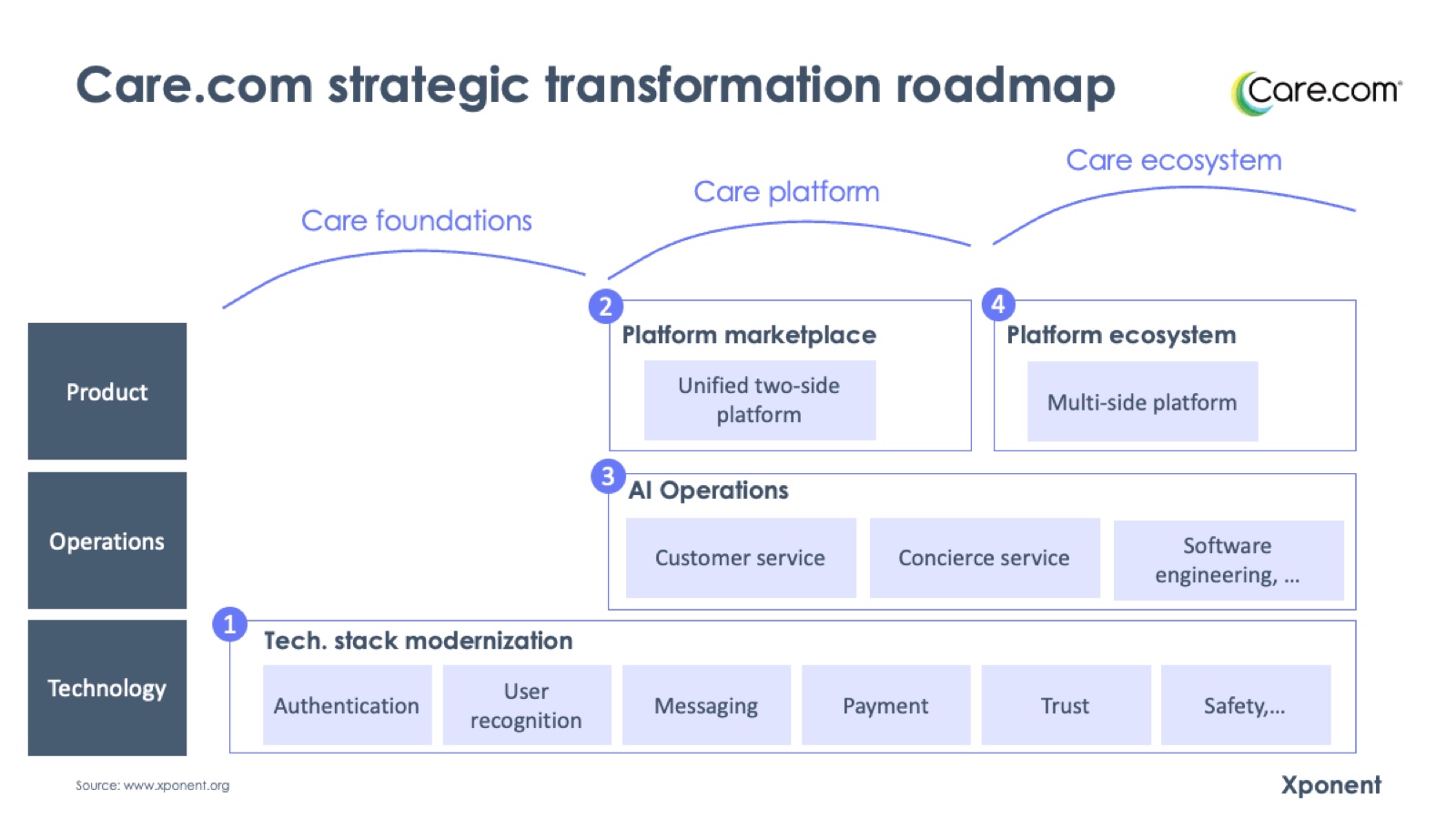
- Product transformation: Redefines how Care.com creates and captures value. The company is moving from two separate marketplaces (one for enterprise clients and one for consumers), to a single unified care marketplace. Unifying supply and demand improves matching, reduces fragmentation, and strengthens network effects. From that foundation, Care.com can evolve beyond a traditional two-sided marketplace into an ecosystem orchestrator: a multi-sided platform that connects families and caregivers with employers, care providers, and public-sector partners that can help fund and coordinate care.
- Operational transformation: Changes the economics of delivering care. Embedding AI through workflow automation helps customer-service teams and care concierges resolve complex cases faster, complete research in hours rather than days, and focus human expertise on empathetic, high-judgment decisions. The objective is not to remove the human element from caregiving, it is to lower cost to serve and improve consistency without sacrificing trust or quality.
- Technological transformation: Provides the technological and infrastructure foundation that makes the first two layers possible. By replacing fragmented systems for authentication, messaging, payments, and trust and safety with a unified platform, Care.com is creating the shared data, workflows, and development velocity needed to operate one marketplace, deploy AI at scale, and continuously test new products and business models.
Sequencing matters: Care.com did not begin with new product features, AI pilots, or ecosystem partnerships. It started by repairing the legacy technology that constrained every other strategic move. The 18-to-24-month infrastructure rebuild created the shared systems, data foundation, and development platform required to unify fragmented marketplace supply, automate high-touch operations, and eventually coordinate a broader care ecosystem. This initial period demanded a visible sacrifice in short-term feature delivery, but it removed the architectural bottleneck that had made the rest of the transformation impossible. The roadmap below represents the order Care.com pursued them: first, rebuild the technology foundation; second, unify supply and demand in a single marketplace; third, use AI to redesign operational workflows and lower the cost to serve; and fourth, extend the platform into a multi-sided ecosystem that brings employers and government into the care equation.
1. Technology stack modernization: Rebuilding the foundations
Paradoxically, the first and most consequential decision was to accept an 18-to-24 month "platform infrastructure rebuild", a deliberate slowdown in feature delivery to rebuild the entire back-end stack. Authentication systems, user recognition logic, messaging infrastructure, payment processing, and trust and safety frameworks were all replaced. The federated architecture that had allowed enterprise and consumer products to drift apart was consolidated into a single delivery platform.
This is the classic "slow down to speed up" trade-off that many technology companies face but few execute with discipline. The risk is well-documented: engineering teams lose motivation when they are rebuilding plumbing instead of shipping features, customers see no visible improvement, and boards lose patience. Care.com managed this risk through sustained leadership communication (e.g., town halls, biweekly standups, weekly operational meetings) and by painting a clear vision of the "AI transformation era" that would follow.
The infrastructure investment is now yielding returns. The company reports more innovation output in the past six to nine months than in the prior eighteen years combined. A claim that, even with executive hyperbole discounted, signals a genuine inflection in deployment velocity.
2. Care Platform marketplace: Unifying Supply and Demand
Historically, Care.com operated what was effectively two parallel marketplaces. Enterprise clients accessed one pool of caregivers through benefits programs and consumer users accessed another through the direct platform. Supply was siloed, demand was fragmented, and the company was shipping eight different product surfaces instead of one.
Care.com redesigned the marketplace business to mitigate fragmentation. The new model, internally branded the "ubiquitous care platform," merges these supply pools into a single caregiver network that serves both enterprise and consumer demand channels. It also expands the definition of supply beyond individual caregivers to include care locations and facilities. The strategic logic is straightforward: a unified supply pool improves match quality for every demand channel, reduces operational complexity, and creates cross-sell pathways across the four primary care occasions that most households manage simultaneously (child care, senior care, pet care, and home care or housekeeping).
When a marketplace unifies its supply side, it creates network effects that compound: more caregivers attract more families, more families attract more enterprise clients, and enterprise subsidies make the platform more affordable for families, which in turn attracts more caregivers. The flywheel, once spinning, becomes the moat.
The company also took a deliberate product swing mid-rebuild, restructuring its go-to-market pricing model, which, while not commercially successful in its initial form, served as a forcing function to energize teams and demonstrate that ambitious moves were still possible.
3. AI Operations: Automating servicing workflows
Care.com focused on deploying artificial intelligence not as a flashy customer-facing feature, but as an operational engine behind the scenes. In a trust-sensitive category like caregiving, the highest-value use of AI is not replacing human judgment, it is removing the administrative drag that prevents human experts from moving quickly. The company is using AI to compress repetitive workflows, surface context faster, and help service teams resolve complex care problems with more speed and consistency.
This matters because service marketplaces often suffer from a hidden scaling constraint: every incremental transaction creates more support, research, matching, trust, and coordination work. If that work scales linearly with volume, growth eventually becomes expensive and operationally brittle. AI changes the equation by turning high-touch internal processes into assisted workflows, allowing Care.com to improve service quality while reducing the cost and time required to deliver it.
Care.com's AI strategy is deliberately non-speculative: it targets two high-volume, high-cost internal workflows where the ROI is immediate and measurable.
- AI customer service: When families or caregivers contact Care.com with issues, AI systems now assist agents by sifting through case histories, analyzing the customer's experience on the platform, and generating recommendations for resolution. The human agent remains in the loop — this is augmentation, not replacement — but the time-to-resolution drops meaningfully when the agent begins the interaction with a pre-analyzed case summary rather than a blank screen.
- AI care concierge service: Where masters-level social workers help families navigate complex care decisions such as transitioning an aging parent into assisted living or understanding payment options for long-term care. The research component of this work — identifying facilities, comparing costs, understanding regional regulations — used to take days of manual effort. AI-assisted research has compressed that timeline to hours, freeing the social workers to spend more time on the high-empathy, high-judgment interactions that cannot and should not be automated.
Looking forward, the company anticipates that generative AI and "vibe coding" approaches will accelerate the final phase of technical debt elimination, potentially compressing what would have been years of remaining migration work into roughly twelve months.
4. Care Platform ecosystem: Building the ecosystem orchestrator
The most strategically distinctive element of Care.com's transformation is its explicit recognition that the two-sided marketplace tension (families cannot afford to pay more, caregivers cannot afford to earn less) is structurally unresolvable without a third payer entering the equation. This fundamentally reframes the company's value creation strategy from pure two-sided marketplace optimization to orchestrating a multi-sided ecosystem.
Care.com orchestrates two third-payer stakeholders simultaneously:
- The enterprises: Already generating revenue through approximately 700 corporate relationships, positions care benefits as an employee retention and loyalty tool. The data is compelling: employees without care support report higher burnout, lower loyalty, and measurable disdain for their employers, while those with backup care, concierge services, or subsidized memberships stay longer and perform better. Recent legislative developments, including the expansion of Section 45F tax credits under new federal legislation, have increased the financial incentive for employers to invest in caregiving benefits.
- The government: Earlier-stage but equally important to the long-term thesis. Through participation in the World Economic Forum's future-of-care initiative, Care.com is positioning itself as a data-rich, commercially grounded voice in policy debates that have historically been dominated by academics and researchers. The company's argument is pointed: more than fifty percent of the United States lives in child care deserts where center-based care is either unavailable or insufficient, and in-home caregivers (Care.com's core supply) are the only scalable solution for these communities. State-level experiments like New Mexico's universal child care program are providing early proof points for the subsidy model.
The Impact: Early signals of transformation
While the full impact of Care.com's transformation will take time to materialize in financial results, the leading indicators are encouraging. Marketplace conversion and match rates are improving from their substandard baselines. The engineering organization is shipping at a pace that was architecturally impossible twelve months ago. The enterprise pipeline continues to expand as more companies recognize care benefits as a retention lever rather than a discretionary perk. And the policy engagement strategy is creating a positioning advantage that no venture-backed point solution can replicate. It requires scale, data, cross-country presence, and the credibility of being an actual operator, not a think tank.
Perhaps the most immediately actionable insight from the transformation is one that benefits both sides of the marketplace simultaneously. Care.com's data reveals that the average household manages four distinct care occasions, and that consolidating multiple care duties (child care, pet care, light housekeeping) into a single caregiver relationship produces a net reduction in total household care spending while increasing the caregiver's total earnings and reducing their scheduling complexity. It is a rare strategic move that creates value for both sides of a marketplace without requiring external subsidy.
Key takeaways for Platform operators and Enterprise leaders
The caregiving economy is not a niche vertical, it is a $400 billion market that touches every working family, every employer, and every level of government. The company that builds an integrated platform, earns trust, and orchestrates the different stakeholders will not merely win the category, it will define it. Key takeaways from Care.com's transformation:
Sequence matters more than speed: Care.com's decision to absorb an 18-to-24 month infrastructure rebuild before pursuing product innovation was counterintuitive but correct. Attempting to build new features on a fragmented back-end would have produced faster visible output but slower real progress. It's key to diagnose whether your constraint is strategic or architectural before allocating resources to either.
Marketplace tension is not always solvable within the marketplace: When the supply side cannot earn enough and the demand side cannot pay more, the answer is not better algorithms, it is a third payer. Care.com's enterprise and government engagement strategies are not ancillary revenue streams; they are structural solutions to the core marketplace equation.
AI operational deployment creates exponential value: Compressing research time from days to hours or equipping service agents with pre-analyzed cases delivers immediate, measurable ROI without the brand risk of consumer-facing AI in a trust-sensitive category.
Network effects through supply unification: Merging enterprise and consumer supply pools does not merely reduce cost, it strengthens network effects, improves match quality, and creates cross-sell pathways that fragmented architectures cannot access.
Policy engagement is a competitive moat: In regulated or subsidy-dependent sectors, the companies that shape the rules will outperform those that merely comply with them. Care.com's WEF involvement and federal advocacy are strategic investments in the operating environment itself.