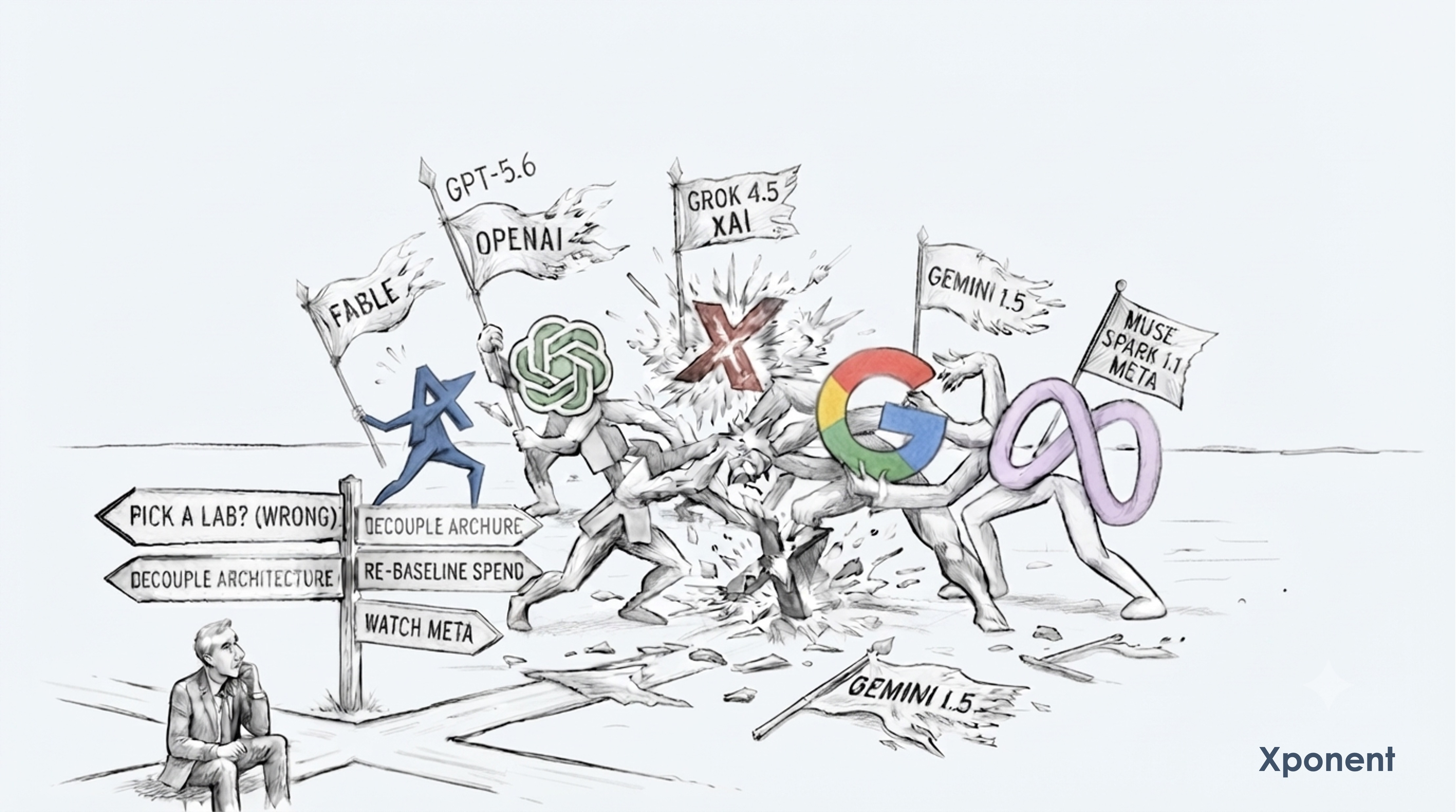

In a single week, four of the world's best-funded AI labs shipped frontier or near-frontier models, and the net effect on the competitive order was close to zero. The leaderboard reshuffled, the leads evaporated within days, and the only visible barrier to entry remained the one that has held since early last year: capital. For enterprise leaders, the strategic implication is not which lab to bet on. It is that the model layer is commoditizing faster than most procurement and architecture decisions assume, and the value is migrating decisively toward price, performance, and the orchestration layer that sits on top.
The AI model pattern: A race with no finish line
Step back from the individual announcements and the shape of the market becomes clear. Since the beginning of last year, the top handful of labs have leapfrogged one another every month or two. No one holds the lead for long, and no one has found a structural mechanism to make a lead durable.
The most recent lap illustrates the point precisely. Anthropic spent roughly two weeks out in front with Fable, its Mythos-class flagship, after regaining access to the model on July 1 following a government export-control episode. OpenAI then closed the gap on July 9 with its GPT-5.6 family, which independent testers put at rough parity. Not ahead by a generation, at par. The lead lasted about a fortnight, which is now the going rate for a frontier position.
This is the central "so what" for anyone allocating capital or building architecture on top of these models. The competitive dynamic is not a winner-take-all race toward a defensible moat, it is a treadmill. Each lab spends billions to pull half a step ahead, and within weeks a competitor spends its own billions to pull level. The barriers to entry that would normally protect a leader, proprietary data, network effects, switching costs, have not yet materialized in a form strong enough to matter. What remains is cash, and cash alone does not compound into advantage when your three closest rivals have equivalent balance sheets and equivalent access to the same chips, the same research talent, and the same benchmark targets.
The strategic reframe follows directly. When capability converges and no lead is sustainable, the axis of competition shifts. It moves from "who is smartest" to "who is cheapest at a given level of smart." July's launches were, almost without exception, priced as much as they were engineered, that is the signal that matters.
What actually shipped
Anthropic: The two-week king with a longer game
Anthropic's role in this cycle is the most instructive of all, because it holds two opposite truths at once. At the model layer, its lead was genuinely fleeting. Fable 5, launched June 9 as the first public model in its Mythos-class tier and positioned above the Opus line, led the market for a matter of weeks, and CoWork set the agenda for agentic workflow products. By mid-July the capability edge was gone and the product concept had been cloned. On that axis, Anthropic simply demonstrated again that being first and best buys a fortnight, not a franchise.
But the fortnight was interrupted by something more consequential than a competitor. On June 12, three days after launch, the U.S. government issued an export-control directive that forced Anthropic to suspend Fable 5 and Mythos 5 worldwide for roughly eighteen days, until the controls were lifted on June 30 and Fable returned globally on July 1. The trigger was an Amazon report of a safeguard bypass, which Anthropic's own testing showed was reproducible on numerous less capable models, including Opus 4.8 and GPT-5.5. The episode introduced a barrier that has nothing to do with cash or capability: regulatory and geopolitical risk. Frontier launches now look less like ordinary product releases and more like negotiated deployments subject to national-security review, and the pause handed valuable time to the Chinese open-weight developers racing to close the gap. For a company weeks away from a public listing, that is a live risk factor, not a moat.
The more important trend sits beneath the model drama, and it is the strongest counter-argument in the market to the thesis that cash is the only barrier to entry. Alongside the Fable restoration, Anthropic shipped Sonnet 5 on July 1 as a near-Opus mid-tier model at introductory pricing of $2/$10 per million tokens, roughly 60% below Opus 4.8, a deliberate move to compete on price/performance in the tier most enterprises actually deploy. Underneath that is a franchise that looks durable in a way the model leaderboard never does. Anthropic overtook OpenAI in U.S. business AI spending earlier this year, its enterprise API share sits near 40%, and Claude Code commands roughly half of the AI coding market, having scaled from about $500 million to $8 billion in run-rate revenue between September 2025 and May 2026. Total revenue reached a $47 billion run rate by May, roughly 80% of it enterprise and therefore stickier than consumer-tilted rivals, against a $965 billion Series H valuation and a confidential S-1 filed June 1 ahead of a listing targeted for late 2026.
The synthesis is the point. At the model layer, Anthropic is the two-week king, living proof that capability leads don't last. One level up, it is assembling the closest thing the market has to a defensible position, positioning itself as the AI coding and Agentic platform for enterprises. Not because its model is the smartest on any given Tuesday, but because its product is embedded in customer workflows and its revenue is contracted, concentrated, and hard to replace. If a moat is forming anywhere in this industry, it is here, built on platform distribution and switching costs, not model benchmark scores.
OpenAI: Caught up, then tripped on its own product
OpenAI's GPT-5.6 release was the headline, and on the model itself the company delivered. The family arrived in three tiers, Sol as the flagship workhorse, Terra as the intermediate option, and Luna as the low-cost tier, priced at $5/$30, $2.50/$15, and $1/$6 per million input/output tokens respectively. OpenAI positioned Sol as its best coding model to date and claimed a state-of-the-art result on the Coding Agent Index at a fraction of Fable's token cost and latency. Independent reaction was more mixed, with several early testers preferring Anthropic's Fable on real tasks, which is exactly what "rough parity" looks like in practice: close enough that preference splits on workload.
The strategic story sits alongside the model, not in it. OpenAI paired the launch with ChatGPT Work, a software layer that builds agentic workflows across connected apps and files, drafting documents, spreadsheets, and presentations and running for hours on a single project without supervision. This is a direct answer to Anthropic's CoWork, which had generated real buzz weeks earlier for doing much the same thing. The competitive tell here is speed of imitation. A differentiated product surface that a rival can replicate in weeks is not a moat. It is a feature.
More telling still was what OpenAI killed. The company discontinued Atlas, its standalone AI browser launched only in October 2025, folding its capabilities into the redesigned ChatGPT desktop app. Atlas will stop working on August 9. Nine months from launch to sunset is a short life for a flagship product, and the retirement carries an honest admission underneath it: the industry has not yet found the right form factor for an AI browser. The new ChatGPT Work experience that replaces it drew criticism at launch for being chaotic and confused. That is not a small detail. When the frontier model is at par with rivals, the product and integration layer is where advantage is supposed to be won, and OpenAI shipped a messy one.
There is a plausible organizational reason for the disorder. Fidji Simo, OpenAI's head of product and business and once floated as a potential successor to Sam Altman, went on medical leave in April and has now stepped down from her full-time role, transitioning to a part-time advisory position. Her responsibilities are being redistributed across Greg Brockman, CFO Sarah Friar, and others. This is the second major reshuffle of the product organization in roughly three months. A confused app experience and a churning management structure are rarely unrelated, and the timing, arriving on the same day as the model launch, is unlikely to be coincidental.
xAI: Back in the game, and priced to fight
xAI's Grok 4.5, released July 8, is the clearest evidence of the market's real dynamic. It does not top the intelligence rankings, it lands around fourth on the independent Artificial Analysis index, but it sits at the leading edge of the price/performance curve. Priced at $2/$6 per million tokens, it undercuts Opus and GPT-5.5 by more than 60% while claiming the top position on agentic tool use and near-parity on coding benchmarks. Trained on real developer session data, it is deliberately aimed at builders rather than at benchmark supremacy.
The significance is the comeback itself. xAI had effectively fallen out of frontier contention last year. It has now bought its way back in and repositioned on the axis that is becoming most relevant: cost per unit of capability. Elon Musk's own framing, an Opus-class model that is faster, more token-efficient, and cheaper, is a price/performance pitch, not a capability-supremacy pitch. That is a rational read of where the competition is heading.
Meta: The pivot from free to paid, and into the cloud
Meta's move is the most strategically interesting of the four, because it is a business-model shift towards B2B dressed as a product launch. Muse Spark 1.1, shipped July 9, is not quite frontier, but it is competitive on coding and agentic work and it comes with a new Meta Model API that charges developers for the first time. Meta priced it at roughly a quarter of what rivals charge, with the company's AI chief calling the pricing aggressive and attractive by design.
Zuckerberg's argument is explicit: the pricing from other labs is extreme and carries very high margins. His response is to attack those margins directly. Meta is now competing head-on with Gemini, OpenAI, and Anthropic for developer spend, and it is signaling a broader move into cloud infrastructure to sell spare compute to outside customers. For a company that spent years releasing models for free, charging for the API is a genuine inflection. It converts a cost center into a revenue line and reframes Meta as a price disruptor rather than an open-weights philanthropist.
The read for Enterprises is straightforward. A well-capitalized incumbent has just declared that the current pricing structure is unsustainable and has moved to undercut it by 75%. When a player with Meta's balance sheet decides margins are the target, the incumbents' pricing power is the thing at risk.
Key Takeaways
Model capability has commoditized, and the competition has moved to price/performance: The clearest pattern across all four launches is that raw capability leads are now measured in days and mimicked in weeks, while the durable differentiation is landing on cost per unit of intelligence. Grok 4.5 and Muse Spark 1.1 are not the smartest models available, yet they are arguably the most strategically consequential launches of the week, because they reset the price expectation. For enterprises, this means the model layer should increasingly be treated as a competitive, multi-sourced input, not a strategic lock-in. Architect for model portability. Assume the best price/performance option will change quarterly, and build the abstraction layer that lets you switch.
The only proven barrier to entry is still cash, and that should worry the leaders more than the laggards: It remains genuinely unclear what structural moat protects a frontier position beyond the ability to keep spending. xAI and Meta both fell out of contention last year and both bought their way back in within months. If capital is the only barrier, then any player with a large enough balance sheet, Meta, Amazon, Google, a sovereign fund, can re-enter at will. Moats built on spending alone are not moats. They are tolls, and tolls invite competitors who are willing to charge less.
The value is migrating up the stack, and the incumbents are fumbling it: With models at parity, advantage is supposed to accrue to whoever builds the best platform and integration layer on top. Yet OpenAI discontinued a flagship browser after nine months and shipped a widely criticized replacement, while product leadership churned for the second time in a quarter. The uncomfortable truth is that no one has yet cracked the right form factor for agentic work, the browser experiment has stalled, and the CoWork/ChatGPT Work category is still messy. This is where enterprise value will ultimately be created or destroyed, and it is currently the least mature part of the market. That is both a warning and an opening.
Enterprises must adapt, and build their own orchestration platform: The right posture in a market with no durable leader is multi-model AI strategy, not a franchise bet.
- Decouple your architecture from any single model provider: Build or adopt a routing layer that lets you swap models by task and by price. Treat the abstraction as core infrastructure, owned by engineering leadership, not as a vendor convenience.
- Invest your differentiation budget in the orchestration layer, not the model: The models are converging and commoditizing. Your durable advantage will come from orchestrating AI towards value creation. Taking advantage of proprietary data, customized AI use cases, end-to-end workflows and the quality of the agentic layer you build on top, which is exactly the layer the labs themselves have not yet perfected.
- Re-baseline your model spend against the new price floor: Grok 4.5 and Muse Spark 1.1 have moved the reference price by more than half. If a hyperscaler-scale player successfully compresses the market's margins, the economics of every model contract you hold will shift. Monitor and reposition current workloads against the cheapest model that clears your quality bar, and renegotiate accordingly.