
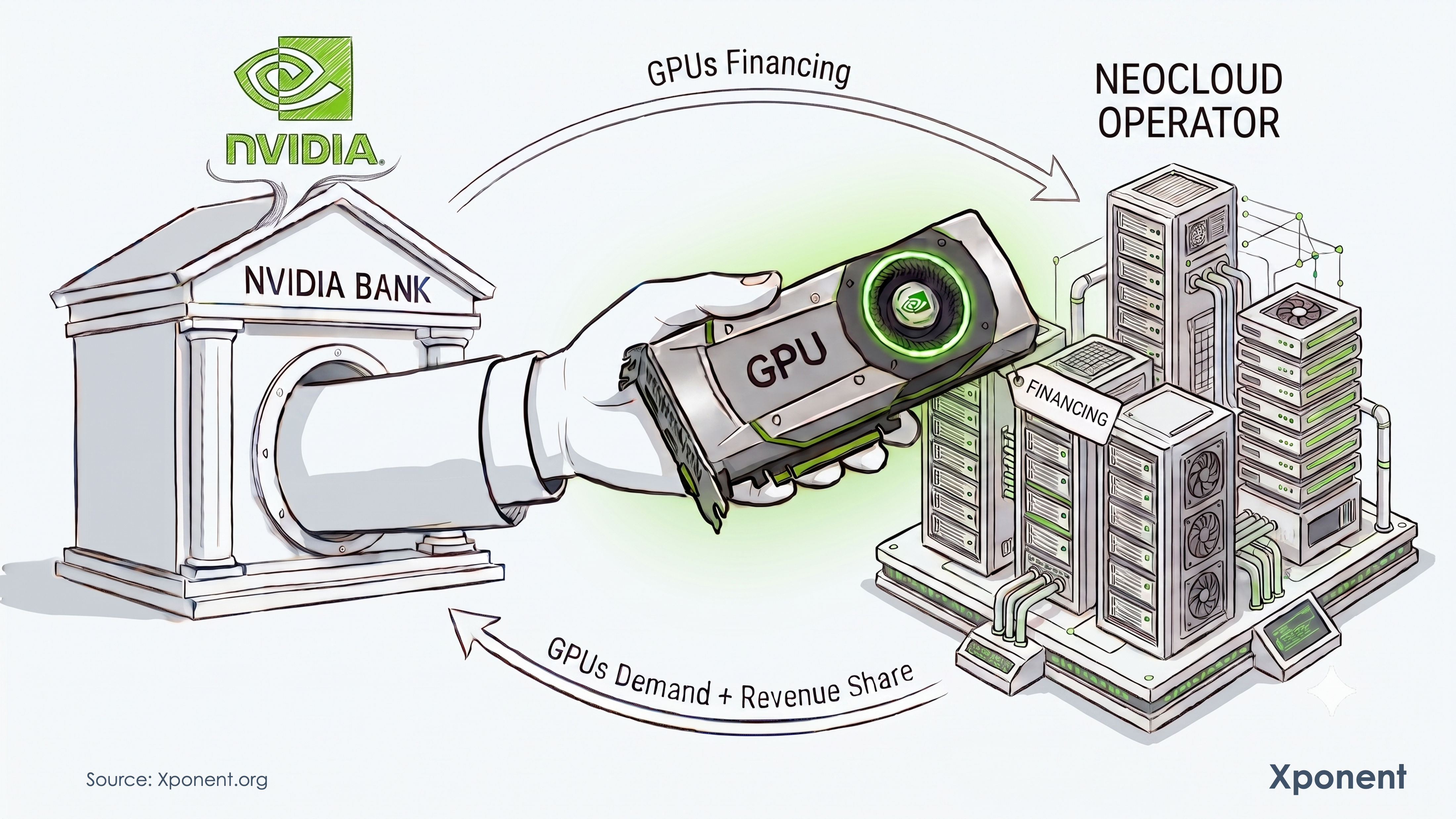

Nvidia has converted itself from a chipmaker into the banker behind the AI infrastructure buildout. Through revenue-sharing backstops, vendor financing, and capacity guarantees, the company is no longer just selling GPUs into the neocloud boom. That solves a real capital bottleneck, but it also places Nvidia in a strategic dilemma: it must simultaneously defend market share against hyperscaler in-housing, finance neocloud growth without encouraging overbuilding, and avoid becoming the bagholder in a commoditizing market. It cannot fully resolve all three. The implications extend well beyond Nvidia's balance sheet and reshape the risk calculus for every investor, lender, and operator in the AI compute stack.
Neoclouds: A $25B+ market growing exponentially
The neocloud sector, specialized cloud providers built exclusively to rent GPU access for AI workloads, barely existed in 2023. By mid-2026, it commands hundreds of operators, multiple public companies, and a funding trajectory that rivals early cloud computing.
The scale is no longer speculative: CoreWeave, the sector's flagship, went public on Nasdaq in early 2025 and surpassed $5 billion in annual revenue faster than any cloud platform in history. Nebius, its closest publicly traded rival, carries tens of billions in contracted backlog against trailing revenue of roughly half a billion dollars. In a single ten-day window in July 2026, four transactions reshaped the landscape: SoftBank announced SB Neo, a U.S.-based neocloud leveraging its 10-gigawatt energy and AI infrastructure pipeline; Together AI closed $800 million at an $8.3 billion valuation; Baseten wrapped a $1.5 billion Series F on the back of roughly 20x year-over-year revenue growth; and Nvidia formalized the financing mechanism that ties all of these stories together.
Neoclouds have moved from niche infrastructure to a measurable market segment. Industry estimates put 2025 neocloud revenue at roughly $25 billion, with 2026 market size moving into the mid-$30 billion range. That still represents a small share of the broader cloud infrastructure market, but a much more meaningful slice of AI-optimized data center demand: compared with the global data center GPU market of roughly $120 billion in 2025, neoclouds already represent about 20% of GPU-centered infrastructure revenue. The growth trajectory is the real story. Forecasts point to neocloud revenue reaching roughly $400 billion by 2031, implying annual growth of 50%+, far above the mid-teens growth expected for the broader data center GPU market. In other words, neoclouds are not yet the whole data center market, but they are becoming one of its fastest-growing and most strategically important segments.
What distinguishes this cycle from prior infrastructure booms is the capital source rotation. Venture capital no longer writes the defining checks. Aramco Ventures led Together AI's round, SoftBank is deploying telecom-scale capital, and sovereign-linked energy money and chip vendors themselves are underwriting the buildout. This shift matters because it changes the incentive structure: these are not investors seeking 10x equity returns on a five-year horizon, they are strategic actors securing supply chains, energy throughput, and ecosystem control.
Nvidia’s AI financing strategy
Nvidia’s financing strategy for neoclouds is designed to solve one problem: GPU infrastructure is expensive, fast-depreciating, and hard to finance unless customers are already locked in.
A neocloud may have demand for AI compute, but lenders still face a difficult underwriting question. GPUs cost billions of dollars, lose value quickly, and become risky collateral if rental prices fall or utilization disappoints. Without large anchor contracts from customers like Meta, Microsoft, or OpenAI, many smaller neoclouds struggle to raise the debt needed to buy Nvidia systems at scale.
Nvidia’s answer is to make those GPU purchases more bankable.
The core mechanism is a capacity backstop. Nvidia agrees to absorb part of the utilization risk by renting back unused GPU capacity at a fixed rate or guaranteeing a minimum revenue floor. In exchange, Nvidia receives a share of the cloud revenue generated by that capacity. This changes the financing equation. A lender no longer sees only a startup with expensive hardware and uncertain demand; it sees a GPU cluster partially supported by Nvidia, the dominant supplier in the market.
Strategically, this does three things for Nvidia.
- First, it accelerates GPU sales. Neoclouds can buy more systems sooner because Nvidia’s support helps unlock external financing.
- Second, it creates an alternative demand channel outside the hyperscalers. Amazon, Google, and Microsoft are all developing their own AI chips. By financing neoclouds, Nvidia builds a customer base that remains deeply tied to Nvidia hardware and software.
- Third, it moves Nvidia closer to recurring revenue. Instead of earning only a one-time hardware sale, Nvidia can participate in the ongoing economics of cloud usage through revenue-sharing arrangements.
But the strategy also changes Nvidia’s risk profile. The company is no longer just a seller of scarce GPUs. It becomes, in effect, a partial credit guarantor for the AI infrastructure boom. If demand remains strong and utilization stays high, the strategy looks brilliant: Nvidia sells more GPUs, strengthens its ecosystem, and captures a share of downstream cloud revenue. If the market overbuilds and GPU rental prices fall, Nvidia could end up supporting excess capacity that it helped create.
That is why the strategy is so powerful and so dangerous. Nvidia is using its balance sheet and market position to expand the neocloud ecosystem, but in doing so, it is also importing some of the financial risk of that ecosystem back onto itself.
Nvidia's strategic dilemma
This is where Nvidia's role changes from supplier to banker. Its formal revenue-sharing backstop, co-authored by CFO Colette Kress, is the most consequential structural development in the AI infrastructure market this year. It converts ad hoc vendor financing into a repeatable capital product and places Nvidia at the center of three strategic trade-offs.
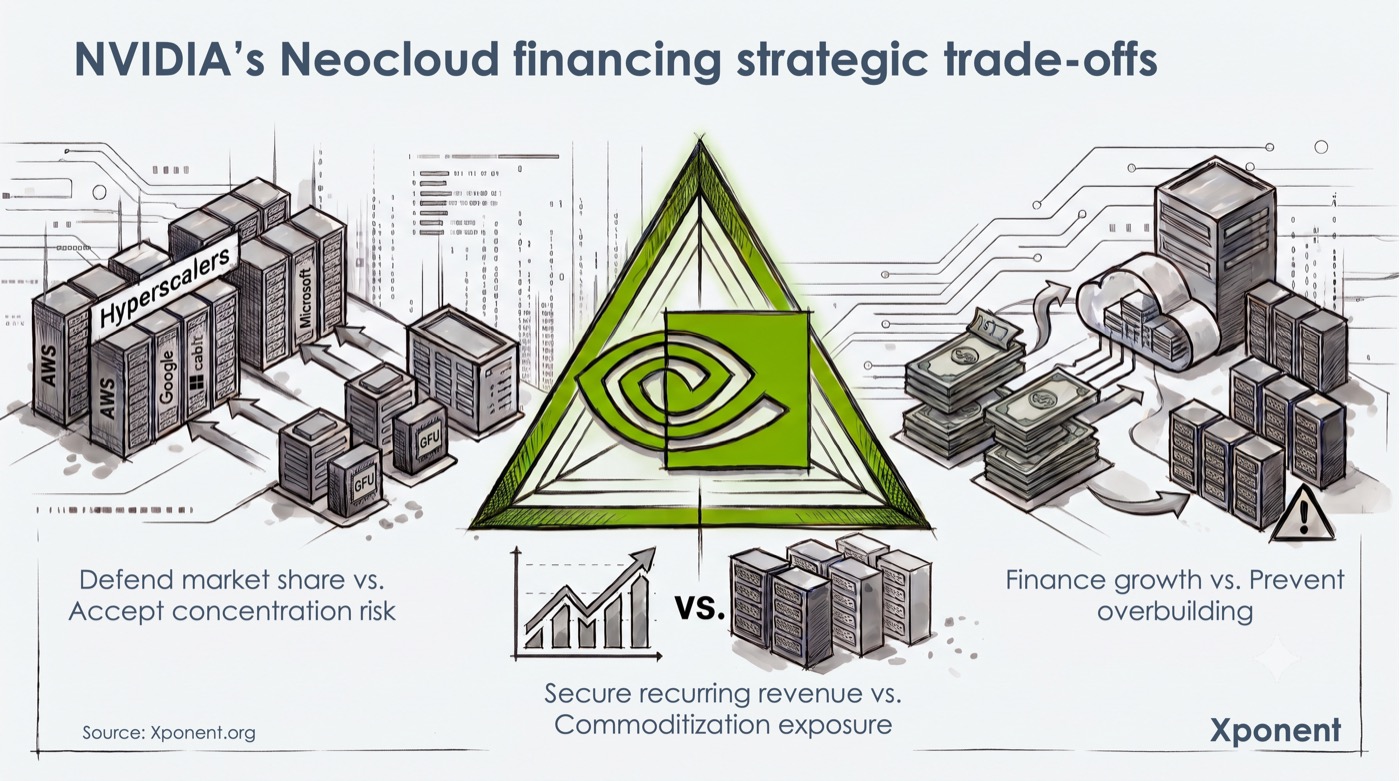
Trade-off 1: Defend market share vs. Accept concentration risk
Nvidia's hyperscaler customers are also its most dangerous competitors. Amazon's Trainium chips, Google's TPUs, and Microsoft's internal silicon programs all aim to migrate workloads off Nvidia hardware. Every dollar of AI compute running on custom hyperscaler chips is a dollar that escapes Nvidia's ecosystem permanently.
Neoclouds offer a structural hedge. They are built almost entirely on Nvidia silicon, market early access to Nvidia's latest chips as their core differentiator, and many count Nvidia as an equity investor. By financing their growth, Nvidia builds a diversified demand base independent of the hyperscalers' internal chip roadmaps.
The cost is concentration risk of a different kind. CoreWeave's $21 billion Meta contract, running through 2032 and structured as take-or-pay, illustrates both the opportunity and the fragility. Meta must pay whether or not it uses the capacity, which makes the cash flows highly stable. But when Bloomberg reported in the same week that Meta is building “Meta Compute” to sell surplus AI capacity directly, CoreWeave and Nebius shares dropped 13–15% in a single session. The hyperscaler that underwrites your revenue today becomes the competitor that undercuts your pricing tomorrow. The SpaceX precedent is instructive: build capacity for internal needs, then commercialize the excess at marginal cost. A hyperscaler-scale entrant with pristine margins and no GPU-collateralized debt can undercut leveraged neoclouds on price almost indefinitely.
Nvidia has traded hyperscaler concentration risk for a different version of the same problem, as its neocloud customers remain structurally dependent on those same hyperscalers for anchor demand.
Trade-off 2: Finance growth vs. Prevent overbuilding
The backstop mechanism works as follows: Nvidia agrees to rent back unused GPU capacity from participating neoclouds at a fixed rate, guaranteeing a floor utilization level on deployed hardware. In exchange, Nvidia takes a share of the cloud revenue generated on that capacity. The first two adopters, Sharon AI with up to 40,000 Grace Blackwell GB300 GPUs under a six-year agreement and Firmus Technologies targeting up to 170,000 GPUs at a 360-megawatt facility in Batam, Indonesia, represent the model's initial proof points.
The program solves a genuine bottleneck. Smaller neoclouds frequently have customer demand in hand but cannot secure financing because lenders view fast-depreciating GPUs as uncertain collateral. Nvidia's backstop makes GPU clusters bankable in a way they were not before.
The overbuilding risk is equally real. By guaranteeing utilization floors, Nvidia enables capital deployment by operators who would not have been funded on their own merits, firms with no anchor contracts, no power procurement expertise, and no software differentiation. Sharon AI, one of the first backstop partners, separately carries a revenue-share facility of up to $200 million with Digital Alpha, meaning portions of its future income are pledged in two directions before it has served meaningful volume. A young company layering vendor financing on top of investor financing has narrowed its margin for error to near zero.
GPU rental rates have already fallen an estimated 50–70% from their peaks. If supply continues to outpace demand growth at the margin, Nvidia could find itself renting back idle GPUs at fixed rates in a falling-price market, effectively paying for its own past revenue.
The backstop converts Nvidia from an equipment vendor into a credit guarantor. This is vendor financing, a practice as old as industrial capitalism, but vendor financing has historically been a hallmark of late-cycle booms. Telecom equipment makers deployed the same playbook in the late 1990s with well-documented consequences.
Trade-off 3: Secure recurring revenue vs. Commoditization exposure
The strategic elegance of the backstop is that it shifts Nvidia from pure hardware sales toward platform economics, creating a recurring, usage-linked earnings stream tied to its customers' success. If backstopped neoclouds thrive, Nvidia collects both hardware revenue and a cut of their cloud income. If they merely survive, Nvidia has still seeded a customer base committed to purchasing its next generation of systems.
The vulnerability is that this platform layer sits atop a commoditizing market. Neoclouds rent access to functionally identical hardware, differentiation is thin, pricing power evaporates the moment supply catches demand, and the only sustainable advantages, whether proprietary software stacks, exclusive energy contracts, or embedded customer workflows, belong to a handful of leaders, not the long tail of hundreds of operators now entering the market.
Together AI illustrates the exception: it pairs Nvidia GPU clusters with proprietary inference-optimization software, giving it a margin and retention advantage that pure-play GPU renters lack. Its $1.15 billion in annual bookings are driven by customers like Cursor and Decagon migrating workloads to cheaper open-source models, a software wedge that creates switching costs. But Together AI is not representative. Most neoclouds are commodity providers in a market where Nvidia's own backstop accelerates the supply that will compress their margins.
Nvidia's recurring revenue aspiration depends on the health of customers whose business model is structurally fragile. The platform economics thesis works only if the neocloud market consolidates to a manageable number of scaled winners, which is likely, but not before significant capital destruction in the long tail.
Risk distribution: Who holds the bag
The losses from a neocloud shakeout will not be distributed evenly. Three tiers of exposure are worth distinguishing.
Venture capital bears the first loss. Equity investors backing the long tail of undifferentiated neocloud startups, firms with no anchor contracts, no power advantage, and no software moat, are the first layer wiped out when a commoditized business fails. The recent funding frenzy, including Upscale AI at $500 million and TensorWave at $350 million, suggests the market has not yet priced this risk.
Nvidia occupies a structurally ambiguous position. It may be taking on financial risk that, by any conventional measure, it does not need. The company sits near a $4.7 trillion market capitalization and enjoys demand that outstrips supply. The backstop is a calculated market-share play, not a revenue necessity. But the tail risk is real: a demand correction forces Nvidia to absorb idle capacity at fixed rates while its own hardware revenue declines, a negative feedback loop that its balance sheet can absorb but its multiple cannot.
Large neoclouds are paradoxically the best-positioned. CoreWeave's debt, while headline-grabbing, is secured by take-or-pay contracts with creditworthy counterparties. Volume risk sits with the customer, not the lender. The vulnerability is not demand but bargaining power at contract renewal, precisely the risk that Meta's infrastructure pivot now amplifies.
Implications and recommended next steps
This is not a story about whether AI needs more compute. It does. It is a story about the financing architecture being constructed to deliver that compute, and whether the incentive structures embedded in that architecture will produce efficient allocation or speculative overbuilding. Key considerations across the ecosystem:
- Nvidia should treat the backstop program as strategically sound but in need of guardrails. Establishing transparent reporting on total backstop exposure, counterparty concentration, and utilization rates will preserve investor confidence. The alternative, opacity in a rising-exposure program, is how vendor-financing stories end badly.
- Neocloud operators must recognize that differentiation is no longer optional. The survivors of the coming consolidation will be firms that have built at least one of three advantages: proprietary software as Together AI has done, exclusive energy access as SB Neo's 10-gigawatt pipeline provides, or locked-in enterprise contracts with creditworthy counterparties as CoreWeave's Meta relationship demonstrates. Operators relying solely on Nvidia's backstop as their financing moat are building on borrowed time and borrowed credibility.
- Hyperscalers considering neocloud partnerships should note that Meta's “Meta Compute” entry redefines the competitive landscape. The question for AWS, Azure, and GCP is whether to build, buy, or partner, and the neocloud shakeout may create acquisition opportunities at distressed valuations within 18–24 months.
- Startups and enterprises should treat the neocloud boom as an opportunity to access cheaper and more flexible AI compute, but not as a reason to ignore counterparty risk. Startups building on neocloud infrastructure should avoid dependence on a single provider, design workloads to remain portable across clouds, and prioritize providers with credible uptime, financing stability, energy access, and software differentiation. Enterprise clients should negotiate shorter commitments, clear service-level protections, and pricing flexibility as GPU rental rates decline; the winning buyers will use market competition to reduce compute costs without locking core AI operations into fragile providers.
- Investors evaluating the sector should apply a straightforward analytical framework: separate the neoclouds with contracted, take-or-pay revenue from those selling spot GPU capacity into a falling-price market. The former category is a defensible infrastructure play. The latter is a commodity trade with deteriorating unit economics and a vendor-financed capital structure, a combination that historically produces poor equity returns.
Nvidia’s role as the AI infrastructure banker has no clean resolution. The company has made itself indispensable to an ecosystem it is accelerating at an exponential pace. That is either the most sophisticated platform strategy since Microsoft’s Windows licensing model, or or a brilliantly engineered demand engine that eventually leaves Nvidia underwriting the excess capacity it helped create. The next quarters will begin to reveal which.